

Travel to Gabon

 3 photos
Gabon is a country on the west coast of Central Africa, bordered by Equatorial Guinea, Cameroon, the Republic of the Congo, and the Atlantic Ocean. Known for its significant oil reserves, rich biodiversity, and political stability relative to the region, Gabon plays a key role in Central African environmental and economic affairs.
Gabonese culture blends over 40 ethnic groups, notably the Fang, Myene, and Punu peoples. Music, dance, and oral traditions remain vital, with instruments like the harp-zither (ngombi) used in rituals and storytelling. The population is predominantly Christian, though traditional beliefs remain influential, especially in rural areas.
Hotels in Gabon
 The Trans-Gabon Railway
The Trans-Gabon Railway (French: Chemin de fer Transgabonais) is Gabon’s only railway line and a key artery for the nation’s freight and passenger transport. Stretching from the Atlantic coast at Libreville’s port of Owendo to Franceville in the southeast, it underpins Gabon’s mining economy and links major interior provinces. Following its privatization in 1999, SETRAG began operating under concession through 2035. The line hauls manganese ore, timber, and general freight and carries roughly 250,000–300,000 passengers annually. It serves mining operations of Compagnie Minière de l’Ogooué (Comilog) and functions as Gabon’s principal inland transport corridor, crossing the Ogooué River multiple times.
 Pongara National Park
Pongara National Park is a protected coastal and estuarine ecosystem in Estuaire Province, Gabon. Situated across the estuary from Libreville, it safeguards mangrove forests, savannas, and nesting beaches vital for sea turtles and migratory birds. Its proximity to the capital makes it one of Gabon’s most accessible national parks. The park encompasses a mosaic of mangroves, coastal forests, savannas, and wetlands. These habitats sustain diverse species, including forest elephants, antelopes, and numerous bird species. Its mangrove zones are among Central Africa’s most intact, serving as nurseries for fish and crustaceans that support local livelihoods.
 Libreville
Libreville is the capital and largest city of Gabon, located on the Komo River estuary along the Gulf of Guinea in Estuaire Province. It serves as the political, economic, and cultural heart of the country, home to about 800,000 residents and the seat of Gabon’s government and industry. Built on coastal hills overlooking the Atlantic, Libreville combines tropical vegetation with urban expansion. The city’s humid equatorial climate keeps temperatures between 23°C and 28°C year-round, with heavy rainfall from October to May. It lies near protected natural areas such as Pongara and Akanda National Parks, reflecting Gabon’s emphasis on conservation.
Ivindo National Park
Ivindo National Park is a protected area in Ogooué-Ivindo Province, Gabon, known for its vast rainforest, powerful waterfalls, and rich biodiversity. Centered around the Ivindo River basin, it is a key site for tropical conservation and part of Gabon’s network of national parks established in 2002. Ivindo National Park harbors several endangered and emblematic species, such as forest elephants, western lowland gorillas, chimpanzees, and numerous endemic birds and amphibians. Research sites like Langoué Baï, a natural forest clearing, provide critical data on wildlife behavior and ecosystem dynamics. Its designation as a UNESCO World Heritage Site recognizes both its ecological importance and relative lack of human disturbance.
 Loango National Park
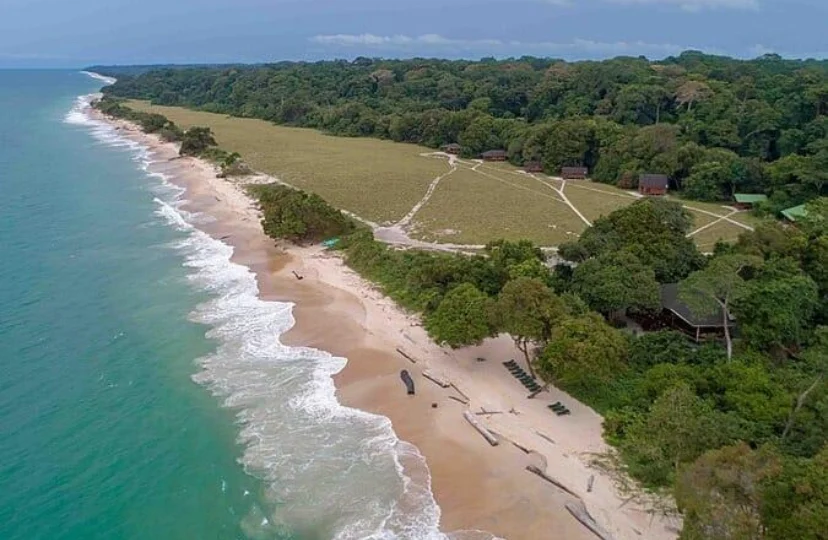
Loango National Park is a protected coastal reserve in Ogooué-Maritime Province, Gabon, often called “Africa’s Last Eden.” Covering about 1,550 km² (600 sq mi), it is famed for pristine beaches where forest elephants and hippos roam, and for its extraordinary mix of rainforest, savannah, mangrove, and lagoon ecosystems. Initially designated a faunal reserve in 1956, Loango became a national park in 2002 within Gabon’s network of 13 protected areas. It is recognized by the International Union for Conservation of Nature as a critical conservation site and forms part of a Ramsar wetland complex. In 2022, Gabon nominated it for UNESCO World Heritage Centre under criteria (vii) and (x) for exceptional natural beauty and biodiversity.