

Travel to Guinea

 3 photos
Guinea, officially the Republic of Guinea, is a coastal country in West Africa bordered by Guinea-Bissau, Senegal, Mali, Côte d’Ivoire, Liberia, and Sierra Leone. Its Atlantic shoreline and mountainous interior make it both geographically and ecologically diverse.
The population is ethnically varied, with major groups including the Fulani (Peul), Malinke (Mandinka), and Susu. Islam predominates (about 85%), alongside Christian and traditional beliefs. French serves as the official and educational language, while numerous indigenous languages are widely spoken. Music and oral storytelling remain key cultural expressions.
Guinea is a country in West Africa bordered by Guinea-Bissau, Senegal, Mali, Côte d’Ivoire, Liberia, and Sierra Leone, with a coastline along the Atlantic Ocean. Its capital is Conakry, a busy port city on the coast. The country has rich natural landscapes, including the Fouta Djallon highlands, which are known for waterfalls, rivers, and green mountains. Guinea is also home to part of the Mount Nimba range, a UNESCO World Heritage Site with unique wildlife. The economy is largely based on mining, especially bauxite, along with agriculture. Despite its natural wealth, Guinea faces challenges in infrastructure, education, and healthcare development.
Hotels in Guinea
 Chutes de Kinkon
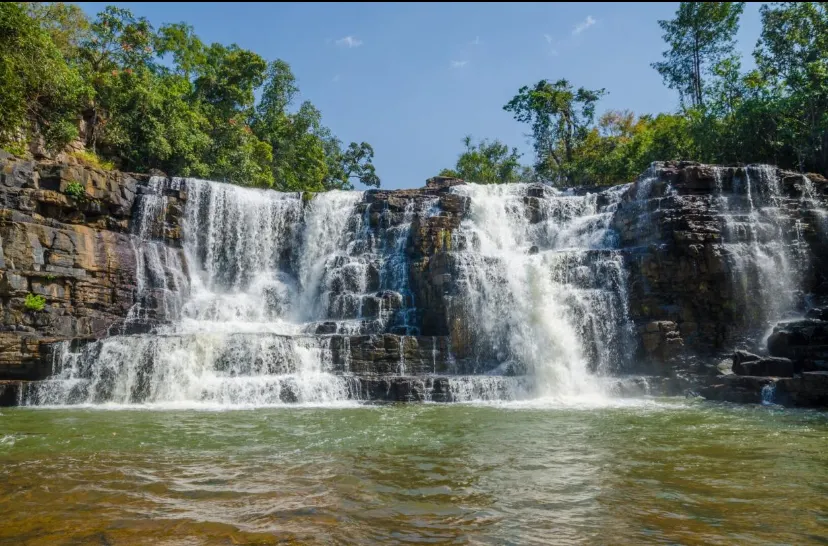
Chutes de Kinkon are a prominent series of waterfalls located near Pita, in the Fouta Djallon highlands of central Guinea. Known for their dramatic drop and scenic canyon setting, the falls are among the country’s most visited natural attractions, drawing tourists and locals for their beauty and cultural significance. Set within Guinea’s mountainous Fouta Djallon plateau, the Chutes de Kinkon form where the Bafing River cascades through a deep sandstone gorge. The falls’ structure reflects the plateau’s erosion patterns, which create sharp escarpments and terraces that channel the river into multiple streams before the main plunge.
 Îles de Los
The Îles de Los are a small group of islands off the coast of Conakry, the capital of Guinea, in West Africa. Known for their natural beauty, sandy beaches, and historical significance, the islands serve as both a local retreat and a reminder of the region’s colonial and trading past. During the 15th and 16th centuries, the islands were used by Portuguese and later British traders as a coastal stopover. Tamara Island once hosted a lighthouse and a colonial prison, remnants of which still stand. In the 19th century, Britain ceded the islands to France, integrating them into French Guinea. The islands’ past reflects the region’s broader patterns of maritime trade and colonial exchange.
Fouta Djallon
Fouta Djallon (also spelled Futa Jallon or Fuuta Jaloo) is a mountainous highland region in central Guinea, West Africa. Known as the “water tower of West Africa,” it forms the source of several major rivers and holds deep cultural and ecological significance. Composed mainly of sandstone plateaus, Fouta Djallon’s terrain is marked by rolling grasslands, steep valleys, and dramatic gorges. The region receives high rainfall, supporting lush vegetation and numerous waterfalls such as Ditinn and Kambadaga. Its ecosystem sustains a diversity of wildlife, including chimpanzees and rare primates, within protected zones like the Parc National du Moyen-Bafing. UNESCO has proposed the massif for World Heritage status because of its hydrological and ecological importance.
 Conakry
Conakry is the capital and largest city of Guinea, located on the Atlantic coast in West Africa. It serves as the nation’s political, economic, and cultural center, and is the country’s primary port and administrative hub. The city’s economy revolves around maritime trade, manufacturing, and services. Conakry lies partly on the narrow Kaloum Peninsula and extends onto nearby Tombo Island, connected by a causeway. Its coastal position grants it a natural deep-water port, which supports Guinea’s mineral exports, including bauxite. The city’s dense urban form contrasts with surrounding mangrove and coastal ecosystems.
 The National Museum of Guinea
The National Museum of Guinea (Musée National de Guinée) is the primary cultural and ethnographic museum in Conakry, Guinea’s capital. Established shortly after the country’s independence, it preserves and showcases the artistic, historical, and cultural heritage of the Guinean people. The museum was founded in 1960, the same year Guinea gained independence from France. It was created to preserve and present the nation’s diverse ethnic traditions and postcolonial identity. Situated in the Sandervalia district of Conakry, it occupies a building that also houses administrative and cultural offices, making it a hub for heritage management.