
Travel to Nauru

 3 photos
Nauru is a small island country located in the central Pacific Ocean, in the region of Oceania. It is the third smallest country in the world by land area, covering only about 21 square kilometers, and it is also one of the least populated nations, with around 10,000 to 12,000 residents. Despite its tiny size, Nauru has an important and unusual history shaped by natural resources, colonization, and economic change.
The island is a raised coral atoll with a narrow coastal belt surrounding a central plateau. Most people live along the coast, while the interior was heavily mined for phosphate over many decades. This mining activity dramatically changed the landscape, leaving much of the central area barren and rocky.
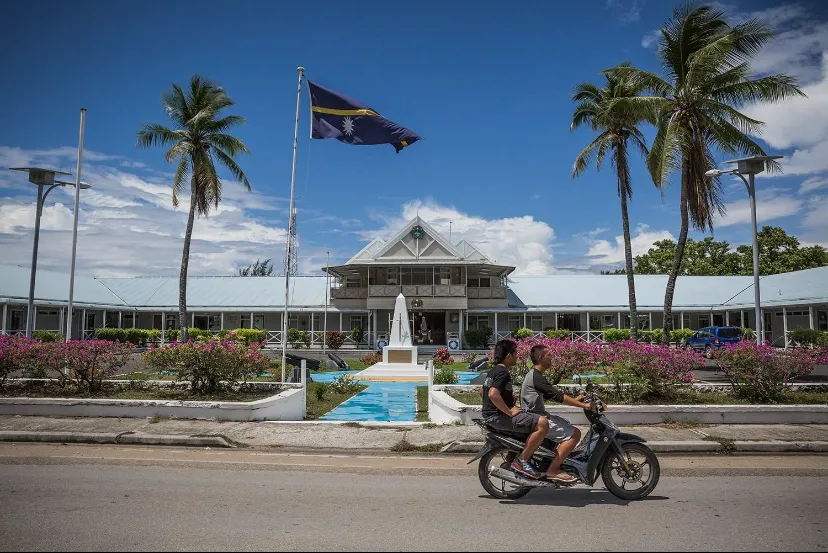
Nauru does not have a formal capital city in the traditional sense, but the administrative center is Yaren. Yaren is where the government buildings, parliament, and international airport are located. Because of Nauru’s small size, the entire country functions almost like a single urban area, with districts blending into one another.
The history of Nauru begins with Micronesian settlers who arrived thousands of years ago. These early inhabitants developed a fishing-based society with strong clan systems and traditional practices. European contact began in the 19th century, and Nauru was later annexed by Germany in 1888. After World War I, it came under the administration of Australia, New Zealand, and the United Kingdom through a League of Nations mandate.
During this period, phosphate was discovered on the island. Phosphate mining became the dominant industry and the main source of wealth for Nauru for much of the 20th century. After World War II, Nauru became a United Nations trust territory administered by Australia. It gained independence in 1968.
At independence, Nauru was one of the richest countries in the world per capita due to phosphate exports. However, poor financial management, over-reliance on a single resource, and depletion of phosphate reserves led to severe economic decline in later decades. As the phosphate deposits were exhausted, the country faced financial hardship and unemployment.
Today, Nauru’s economy is small and heavily dependent on external assistance, particularly from Australia. Other sources of income include fishing licenses, international aid, and hosting regional processing centers for asylum seekers at various points in recent history. These arrangements have been controversial but economically significant.
Geographically, Nauru is unique. The coastal strip is narrow and fertile compared to the central plateau, which has been extensively mined and is largely uninhabitable. The island has no rivers, and freshwater is limited, relying on rainwater collection and desalination. The environment has been heavily impacted by phosphate extraction, leaving long-term ecological challenges.
The climate in Nauru is tropical, with hot temperatures and high humidity year-round. Rainfall can vary, and the island is vulnerable to droughts. Climate change also poses a serious threat due to rising sea levels and coastal erosion, which could significantly affect infrastructure and housing along the narrow coastal zone.
The population of Nauru is ethnically mixed, primarily made up of indigenous Nauruans along with small communities of other Pacific Islanders, Australians, and Asians. The official language is Nauruan, but English is widely used in government, education, and business.
Nauruan culture is influenced by Micronesian traditions, with strong emphasis on family ties, community cooperation, and respect for elders. Traditional music, dance, and storytelling remain important, though modern influences are also present due to globalization and contact with other countries.
Food in Nauru is based on imported goods and local fishing. Fish, coconut, and breadfruit are traditional staples, but much of the population now relies on imported rice, canned foods, and packaged goods due to limited agricultural production.
Transportation on the island is simple, with a ring road circling the entire country. There are no major cities or towns beyond the districts, and travel between locations is quick due to the island’s small size. The international airport in Yaren connects Nauru to a limited number of regional destinations.
Education and healthcare services are provided by the government, but resources are limited, and many specialized services require travel abroad, often to Australia or Fiji.
In conclusion, Nauru is one of the smallest and most unique countries in the world, shaped by its phosphate mining history, limited geography, and modern economic challenges. Despite its difficulties, it maintains a strong cultural identity and continues to adapt to environmental and economic pressures in the Pacific region.